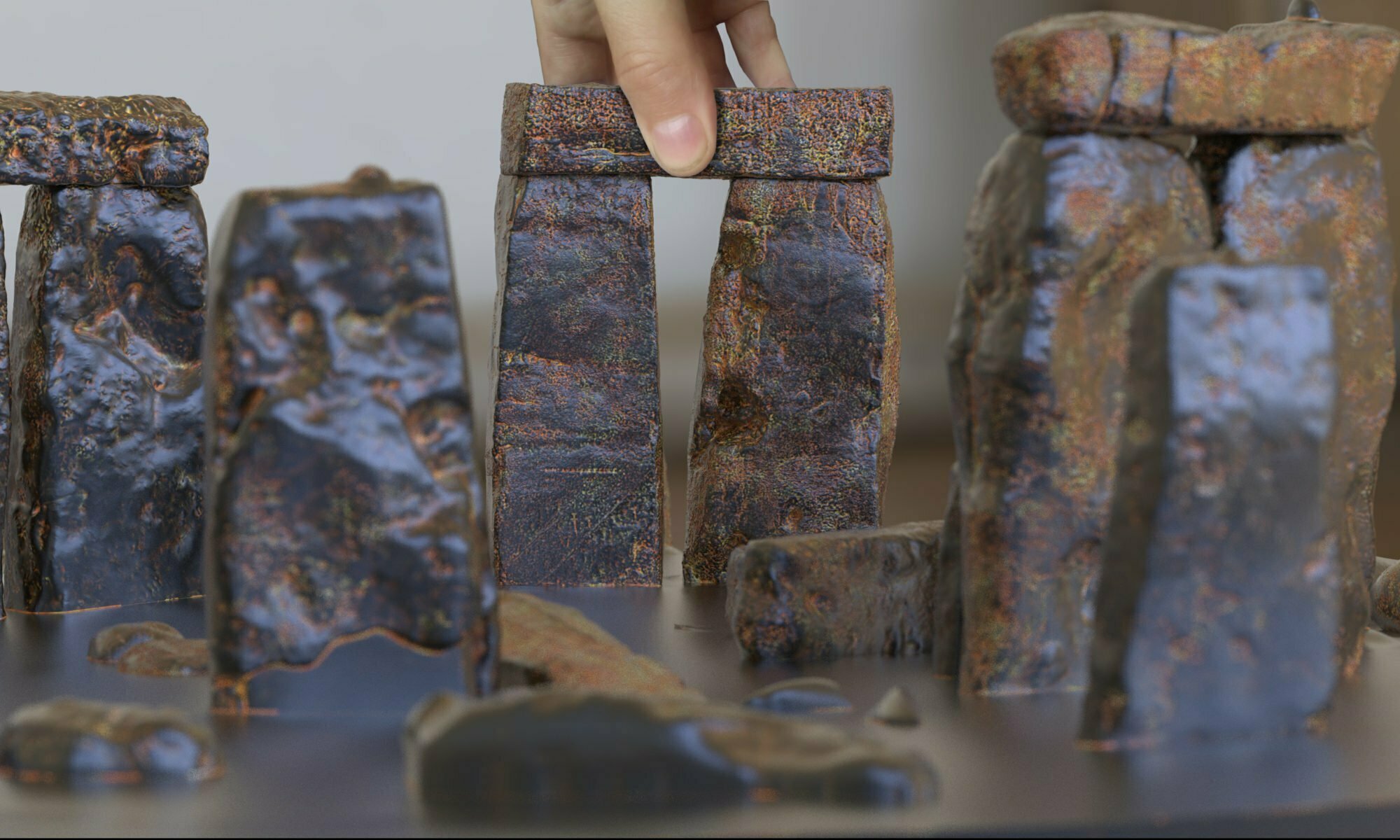
What sarsen is
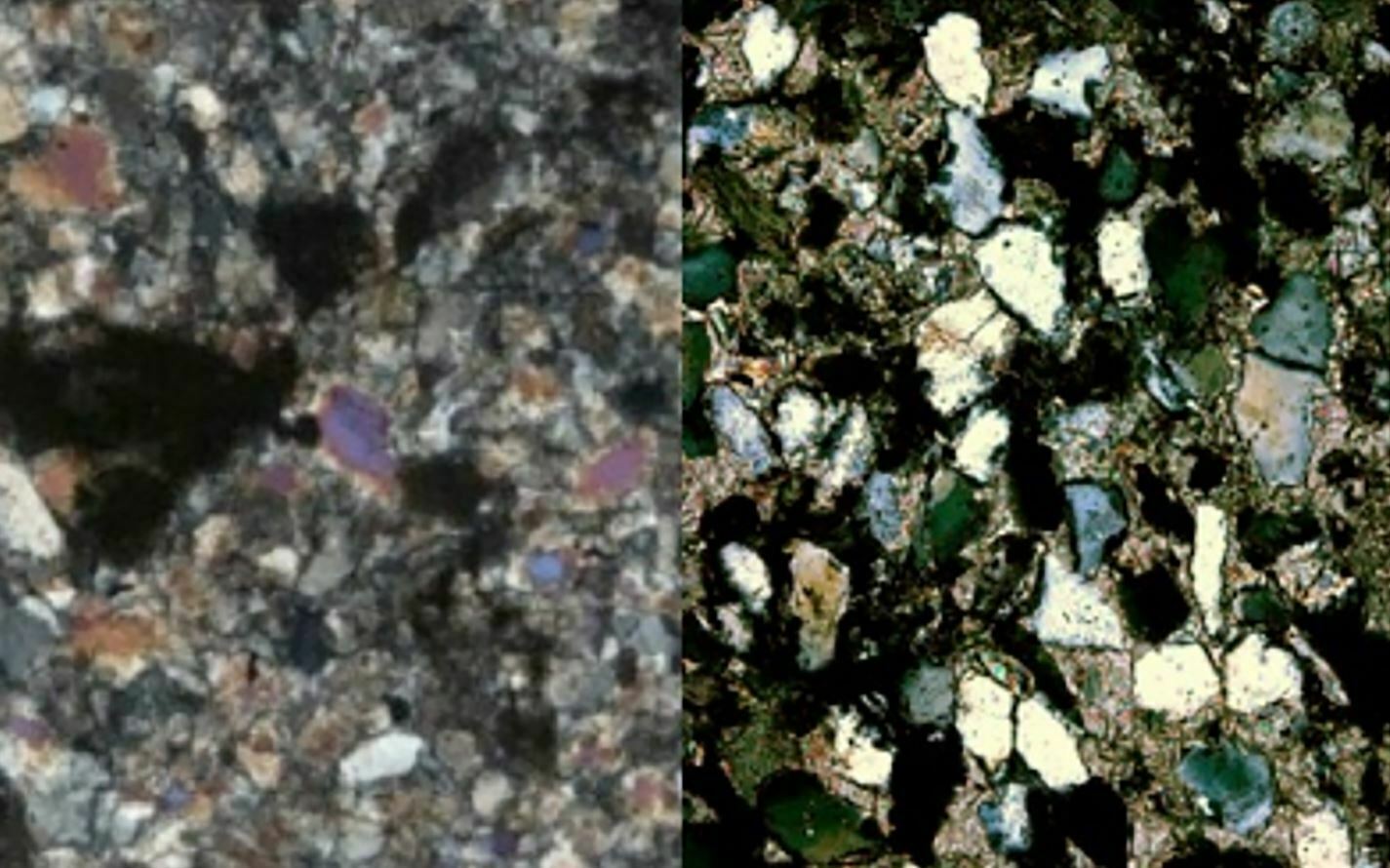
Sarsen is a silcrete. Quartz sand, cemented by more quartz. Geologists call it a quartz arenite: sand grains that are almost pure silica, grown together until the rock is one hard mass with tiny crystal-lined holes (vugs) where the cement never quite closed. The odd grain of tourmaline, rutile, zircon and chromite. A little iron oxide for colour. That is the whole recipe.
Rob Ixer’s description of a typical Stonehenge sarsen, from the Cursus field lithics paper, is worth reading slowly:
Macroscopically the sarsen is a greyish-red, indurated, fine-grained, unbedded, sandstone. Microscopically the rock is a vuggy, locally grain-supported quartz arenite comprising single, sub-rounded to sub-angular, detrital quartz grains with authigenic overgrowths and euhedral terminations growing into void spaces.
Ixer, R. A. and Bevins, R. E. (2010) The petrography, affinity and provenance of lithics from the Cursus Field, Stonehenge. Wiltshire Archaeological and Natural History Magazine 103, 1-15.
Translation: a hard, unlayered, faintly reddish sandstone; under the microscope, sand grains wearing overcoats of new quartz, with proper pointed crystals poking into the gaps.
How it formed
Southern England, some 60 million years ago. The chalk has been lifted out of the sea and a skin of sand and clay has been laid over it. Silica-rich groundwater moves through the sand and, where conditions are right, precipitates quartz onto the grains. Not everywhere, not evenly. Lenses and pockets of the sand turn to stone; the rest stays sand.
Two things follow. First, the cementation was patchy, which is why sarsen is vuggy and knobbly and why boulders vary so much from one to the next. Second, the sand was a land surface at times, with plants growing in it. Roots left channels that were later filled or lined with quartz, and those root holes show in the stone today. Older books say palm roots. The roots are real; the palms are Victorian guesswork.
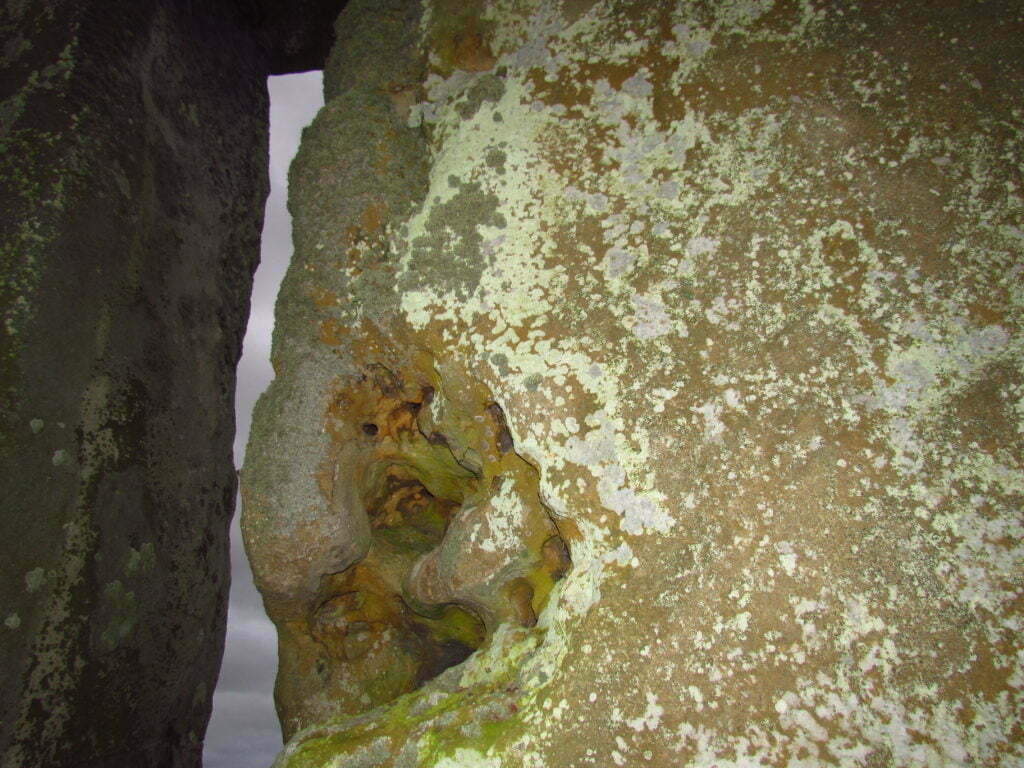
The pale lines that run across some of the stones are quartz veins. Same water, later. Once the silcrete had set, it cracked, and silica-bearing water found the cracks and lined them with quartz, just as it had lined the vugs. Some of what reads as a vein at arm’s length is a fracture stained with iron rather than filled with quartz; the two look alike until you are close.
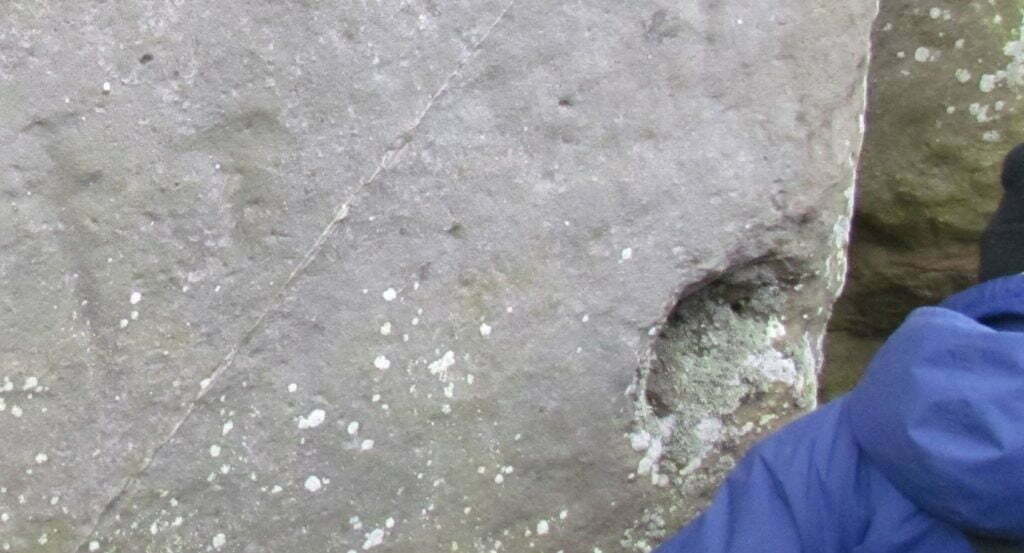
The exact age of the silicification is not settled. Palaeogene sediments, cemented at some point between roughly 60 and 30 million years ago, is as tight as the literature allows.
Broken up and slid downhill
Everything softer than the sarsen has since been stripped away. The sand went, the clay went, and the hard lumps were left sitting on the chalk. Then the cold did the rest. In the last glacial period the ground here was frozen for much of the year, and in summer the top layer thawed into a chalk sludge. Boulders on the slopes crept downhill on it, a little each year, and collected in the valley bottoms as sarsen trains.
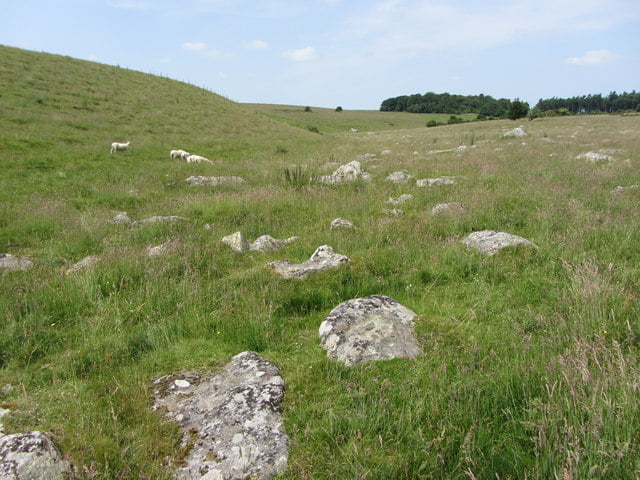
The Marlborough Downs hold the largest concentration in Britain: Fyfield Down, Piggledene, Lockeridge Dene, West Woods. The Valley of Stones in Dorset is the best single example of a train. Kent has its own sarsens, used in the Medway megaliths.
The Valley of Stones National Nature Reserve, Dorset, OS grid reference SY601874. Freeze-thaw at the end of the last glacial period broke up the sarsen on the hilltops and slumped it down the valley.
Colour
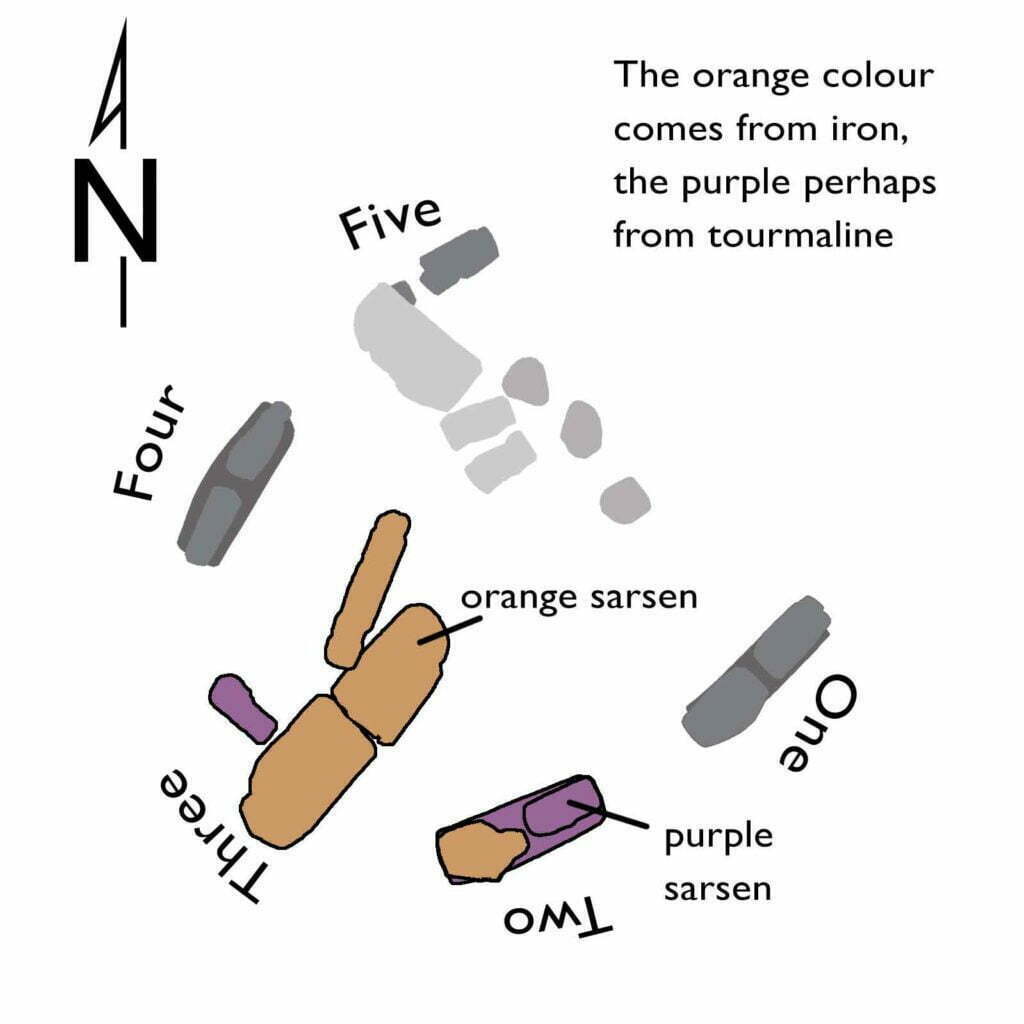
Fresh sarsen is white to grey. Iron oxide pushes it towards yellow, orange and rust, and different boulder fields carry different amounts. At Stonehenge the trilithons show it plainly: Stones 53, 154 and 56 read purple-grey, while 54, 55 and 156 read orange. The orange is iron. The purple may be tourmaline; nobody has tested it.
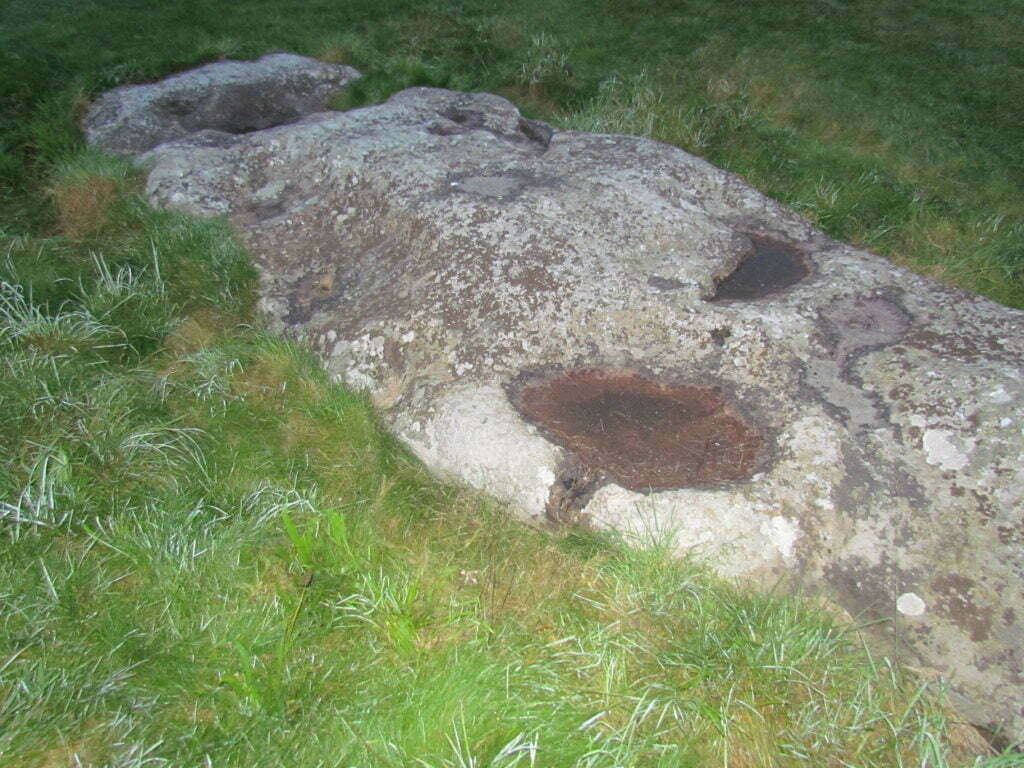
In damp weather, sarsen sweats. Water condenses on the surface and the stones look like giant lumps of coarse sugar. The reason is thermal mass. A block of sarsen holds the night’s cold long after the air has warmed, so on a mild wet morning the stone surface sits below the dew point of the air touching it and water condenses out, exactly as it does on a cold bottle. The vugs hold the beads. William Stukeley complained that sarsen houses were always moist and dewy in winter and rotted the furniture.
Hard, and hard to work
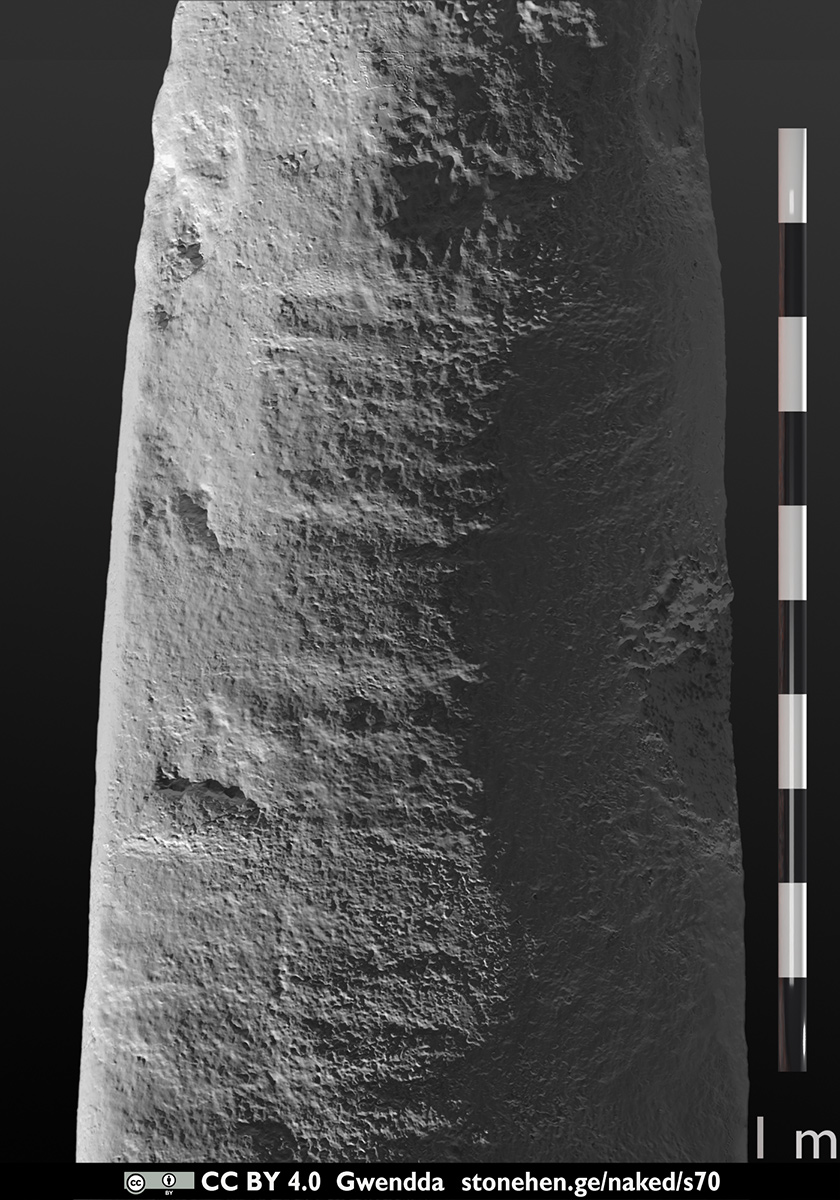
Quartz is 7 on the Mohs scale. Steel is about 5. Weathered sarsen lying on the surface has a crust that nothing softer than itself will mark, so the builders hit it with sarsen and flint hammerstones, the larger mauls up to seven pounds. The long vertical ridges were bashed in first, then the finer transverse tooling four to five inches apart, then on the inner faces a polish.
There is a wrinkle. Sarsen is not hard all the way down. William Cunnington, digging around Stonehenge in the early 1800s, wrote that sarsens “when first dug out of the ground they are soft like freestone just quarried” and that a broken one could be crumbled inside “between your fingers like Lump Sugar”. The geologist Kellaway made the same point after three very large sarsens, one over 7 m, came out of a sinkhole at Aston Rowant ahead of the M40 in the 1970s: buried sarsen can be relatively soft, and it is weathering that hardens it. Isobel Geddes added that the only sarsens of Stonehenge size found in modern times have all been below ground, in swallow holes, protected from the weather.
Nobody has measured it. There is no published hardness test of buried sarsen against surface sarsen, and Cunnington does not say how big his soft ones were or how quickly they firmed up. Two things could be going on. Freshly cut freestone holds pore water and cuts easily for weeks until it dries; that is what his comparison means to a mason. Or the weathered crust is a skin of silica precipitated at the surface over thousands of years, in which case the inside of a boulder is softer than its outside and always was. Either way, a stone dug from a pit and shaped while it was fresh asks less of a maul than one that has sat in a field since the last ice age.
The vugs, fractures and quartz veins made every blow unpredictable. And the dust is crystalline silica. Breathe enough of it for long enough and you get silicosis. The builders will not have known the word, but some will have died of it.
How the stones were split, pecked and polished, where the waste went, and why the chippings under the turf at Stonehenge turn out not to belong to the stones standing there, is on Shaping the stones.
Sources. Cunnington MSS Book 4, p.34, quoted in Field, D. and Pearson, T. (2010) Stonehenge World Heritage Site Landscape Project: Stonehenge, Amesbury, Wiltshire, English Heritage Research Report 109. Bowen, H. C. and Smith, I. F. (1977) Sarsen stones in Wessex. Antiquaries Journal 57, 185-196. Geddes, I. (2000) Hidden Depths: Wiltshire’s Geology and Landscapes. Geddes, I. and Walkington, H. (2005) in The Avebury Landscape. Harding, P. (2025) Demystifying sarsen: breaking the unbreakable. Antiquaries Journal 105, 359-379. Open access.
Where the Stonehenge sarsens came from
For centuries the answer was “the Marlborough Downs, probably”, with occasional guesses as far as Norfolk. In 2020 it became testable.
Nash and colleagues took portable XRF readings from all 52 surviving sarsens at the monument. Fifty share a consistent chemistry. Two do not: upright Stone 26 and lintel 160, which match neither the fifty nor each other. They then compared a core drilled from Stone 58 in 1958, returned from Florida by Robert Phillips in 2018, against sarsen samples from twenty sites across southern England. The closest match was West Woods, near Marlborough, about 15 miles north of Stonehenge.
Nash, D. J. et al. (2020) Origins of the sarsen megaliths at Stonehenge. Science Advances 6, eabc0133. Open access.
West Woods is the best current match for most of the sarsens, including the undressed Heel Stone, though some believe that one was lying close by and was raised out of the pit beside it. West Woods is not a closed answer. The builders were choosing boulders from surface scatters, not opening a quarry, and sarsen of that character lay across the Downs. Since 2020, a refitted dressing flake from the Stonehenge debitage has been matched to Monkton Down, a few miles from West Woods, so at least one more source area is in play. Stones 26 and 160 remain unmatched.
And West Woods may match areas closer to the monument that were then picked clean. There is a theory that Stone 11 is such a runt, small and short, because the local pickings had become so scarce. And that the circle was never finished, because they ran out of local stones.
How many
Fifty-two sarsens survive of an estimated eighty or so: the outer circle uprights and lintels, the five trilithons, the Heel Stone, the Slaughter Stone and the Station Stones. All sarsen.
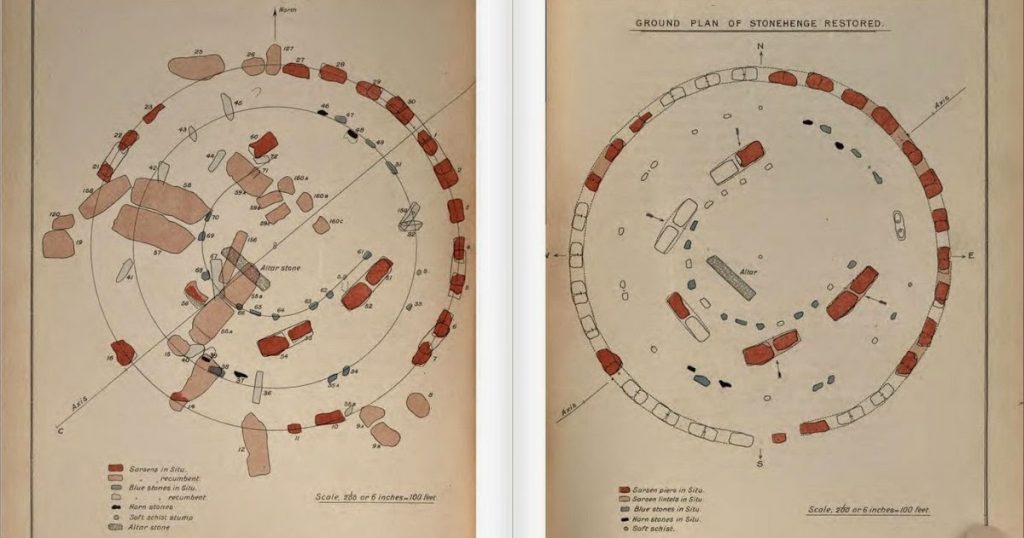
The smaller stones inside are the bluestones, around 43 of them still present, and they are a different story entirely. That page is coming.
Sarsen elsewhere
The Avebury circles and West Kennet long barrow. Kit’s Coty House and the other Medway megaliths in Kent. The ramparts of Uffington Castle, revetted with sarsen. Later, sarsen was cleared from fields, set as gateposts and boundary stones, built into church walls, and in the nineteenth and early twentieth centuries cut for kerbs and paving on the Marlborough Downs until the trade died out in the 1930s.
The name
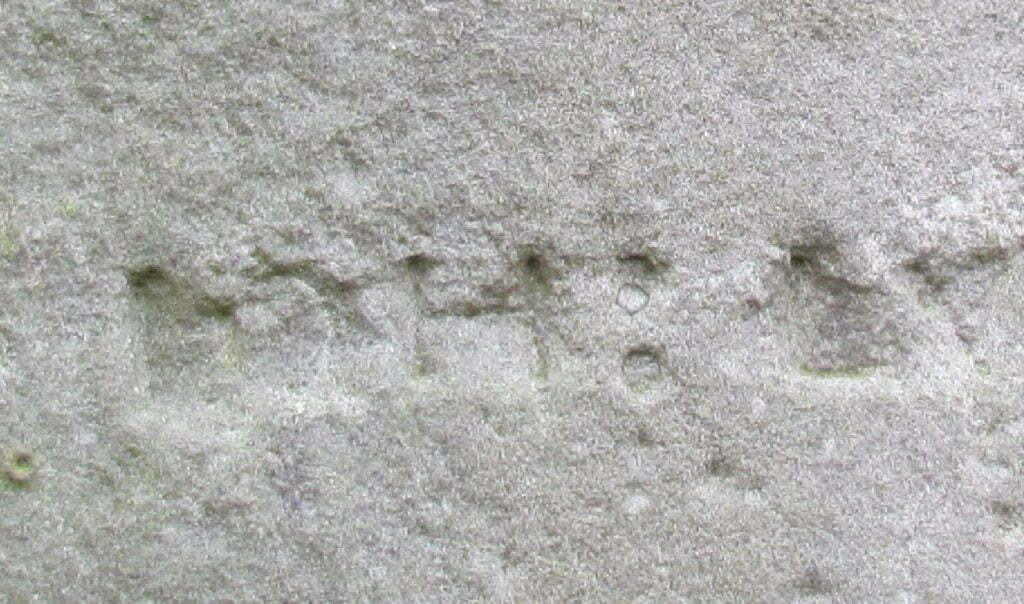
Sarsen is generally taken as a corruption of Saracen: foreign, heathen, not of here. Local names were grey wethers, because a field of them at dusk looks like a flock of sheep. The Grey Wethers stone circles on Dartmoor borrowed the name; those stones are granite.
What the builders saw
Not one of the above paragraphs would have meant anything to them. So put yourself in the valley.
You know flint. Everyone knows flint. You dig it out of the chalk, you knap it, you cut with it. And here is a boulder the size of a hut, lying in a row with its brothers down the valley bottom, harder than anything you own, with flint pebbles locked inside it like currants in a pudding. Who did that? Sweating on a wet morning. Rusting in its hollows. Holes in it where something used to grow.
The farmers who came after had an answer. Sarsens breed. No use clearing them off a field, more will come up. They wreck ploughs out of spite.
I like the purple ones. Skinny Stone 53 and his lintel are purple; fat 54 beside him is orange. The great trilithon in the middle is the other way round: fat 55 and the lintel orange, skinny 56 purple. If it were not for the heights, I would wonder if somebody muddled the pairs. They did not. But I would wonder.
And I like that proper crystals are growing in the holes. Euhedral terminations. Say it out loud. The rock is still finishing itself.
Soft when dug, hard when dry. I wonder if the trick was never the heavy maul. It was the handfuls of wet mud.